Featured research · CosMAP
Making high-dimensional structure visible.
I developed CosMAP (Contrastive Manifold Approximation and Projection) which is a new graph-based unsupervised dimensionality-reduction method for producing faithful and interpretable embeddings of sparse, noisy data.
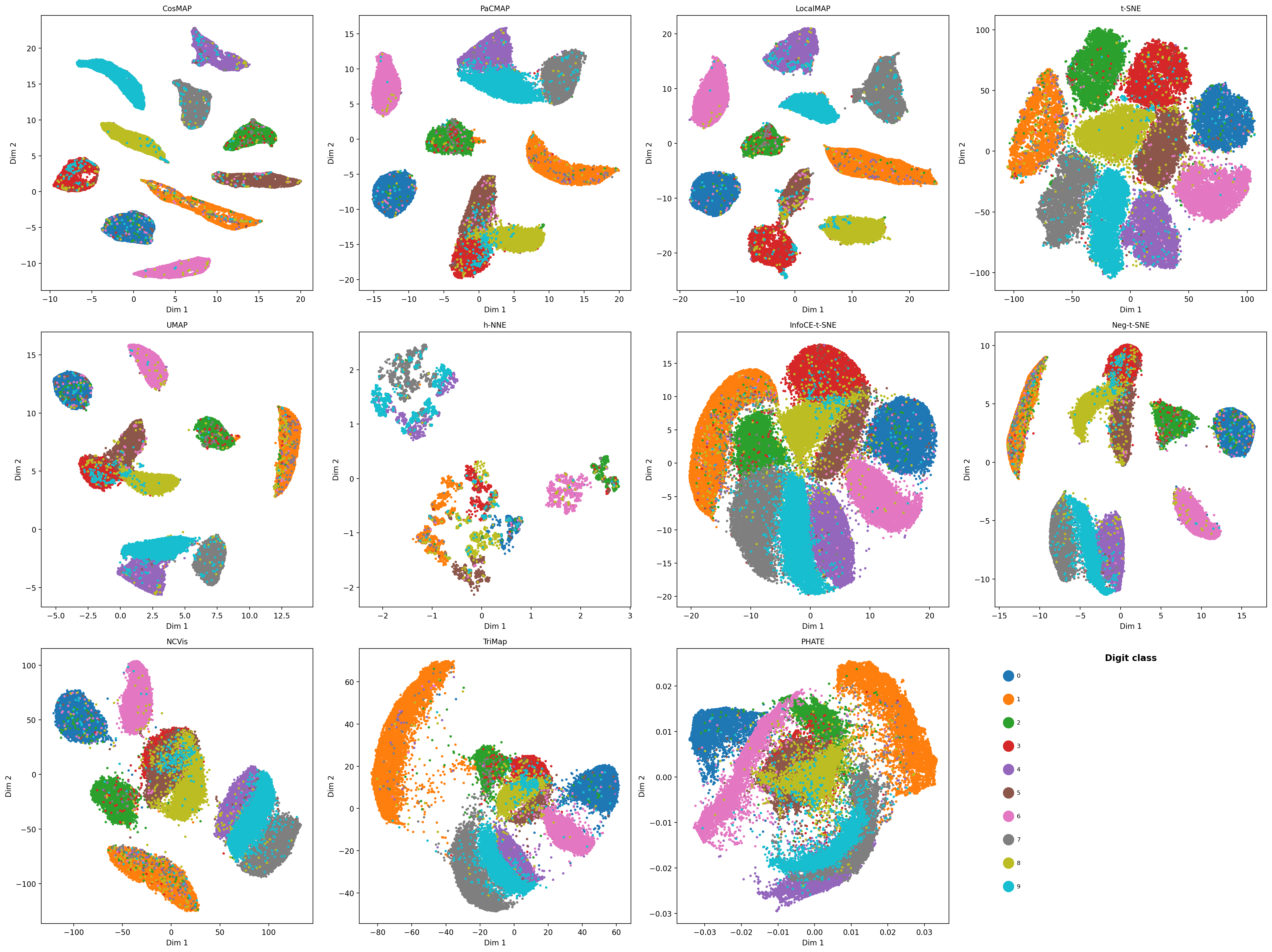
On MNIST, shown here, CosMAP organizes 70,000 handwritten-digit samples with 784 features into a two-dimensional map. Each point is one image; color indicates its true digit label. Compact neighborhoods and distinct regions make both local relationships and the overall class structure easier to inspect.
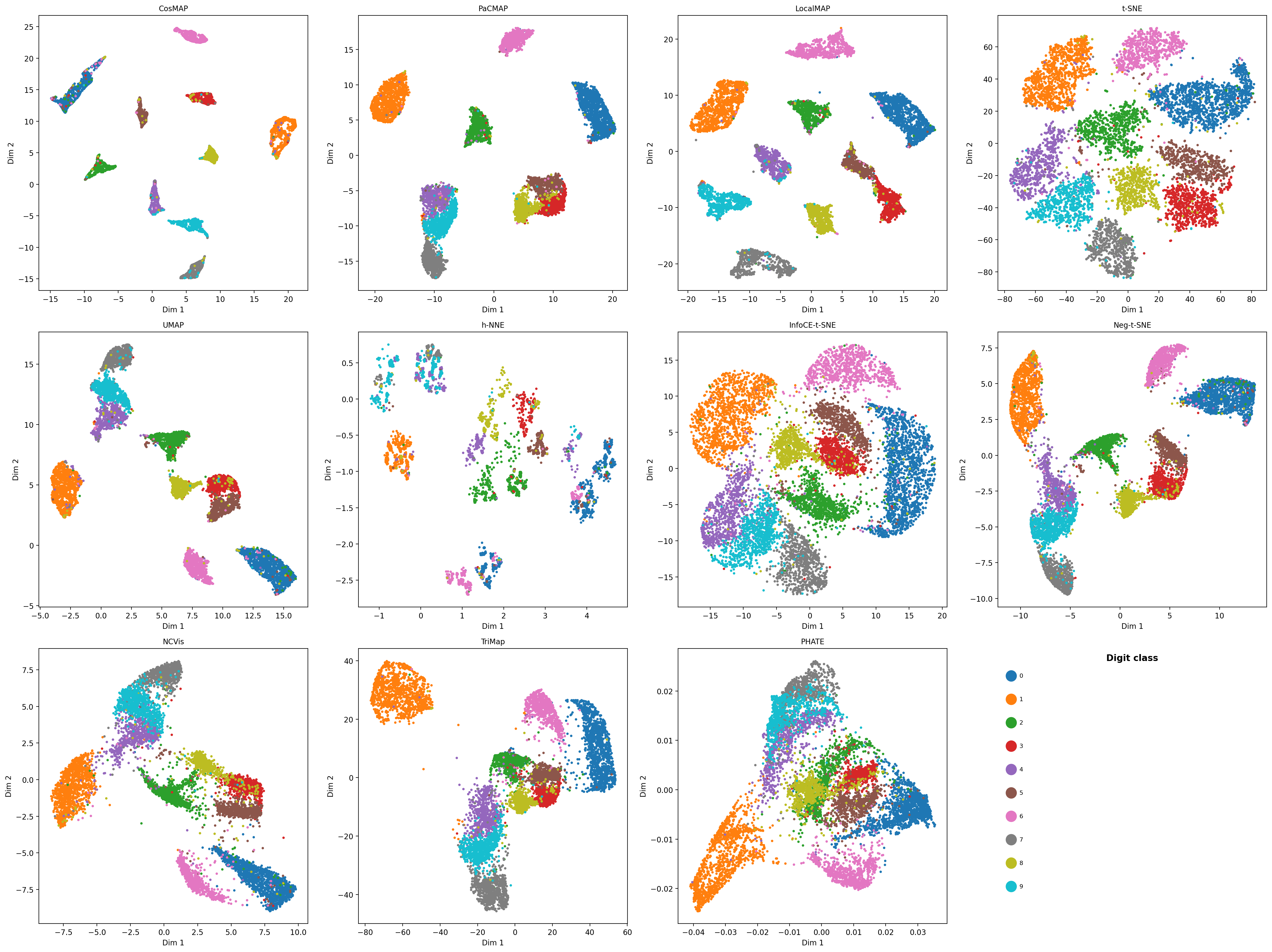
Result: On the MNIST and USPS benchmarks, CosMAP yielded the most interpretable two-dimensional cluster structure among the evaluated methods, with LocalMAP providing the closest competing performance. Its embeddings produced compact, well-separated digit populations while maintaining a readable global organization.
Comparative evaluation: CosMAP was evaluated against PaCMAP, UMAP, LocalMAP, t‑SNE, TriMAP, PHATE, PCA, h‑NNE, InfoNCE‑t‑SNE, Neg‑t‑SNE, and NCVis across diverse image, single-cell RNA-seq, and genealogical datasets.
The method combines cosine-similarity neighborhoods with temperature-normalized contrastive affinities, an attractive–repulsive objective, and a two-phase refinement strategy.